
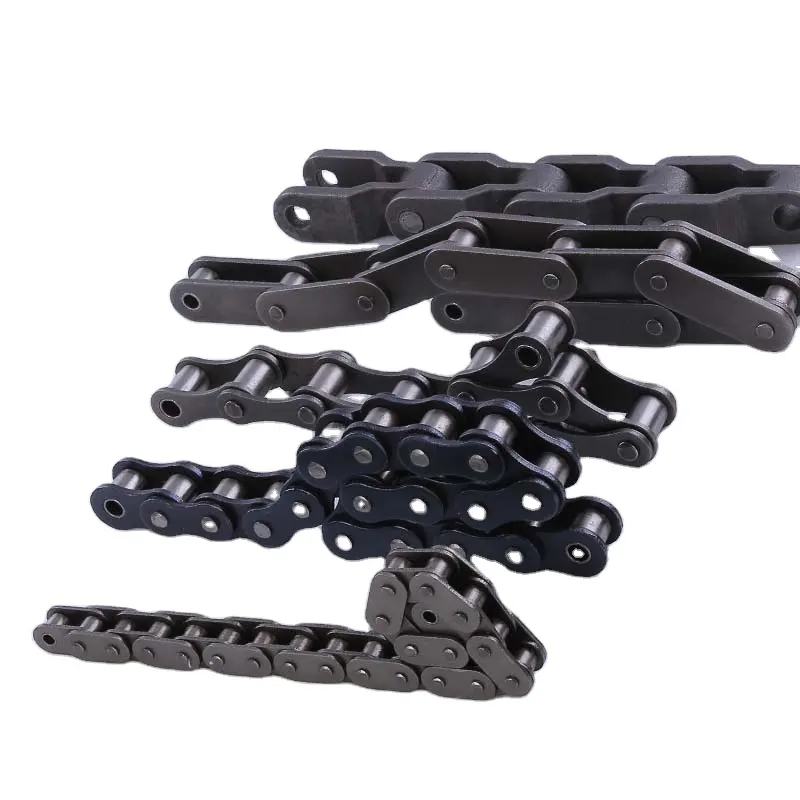
Descrição do produto
| Chain No | Pitch | Width Between Inner Plates | Pin Dia | Pin Length | Inner Plate Depth | Average Tensile Strength | Weight |
| Mm | mm | mm | mm | mm | mm | Kn | kg/m |
| 04B-1 | 6.000 | 2.80 | 1.85 | 6.80 | 5.00 | 3.2 | 0.11 |
| 05B-1 | 8.000 | 3.00 | 2.31 | 8.20 | 7.10 | 5.9 | 0.20 |
| *06B-1 | 9.525 | 5.72 | 3.28 | 13.15 | 8.20 | 10.4 | 0.41 |
| 08B-1 | 12.700 | 7.75 | 4.45 | 16.70 | 11.80 | 19.40 | 0.69 |
| 10B-1 | 15.875 | 9.65 | 5.09 | 19.50 | 14.70 | 27.50 | 0.93 |
| 12B-1 | 19.050 | 11.68 | 5.72 | 22.50 | 16.00 | 32.20 | 1.15 |
| 16B-1 | 25.400 | 17.02 | 8.28 | 36.10 | 21.00 | 72.80 | 2.71 |
| 20B-1 | 31.750 | 19.56 | 10.19 | 41.30 | 26.40 | 106.7 | 3.70 |
| 24B-1 | 38.100 | 25.40 | 14.63 | 53.40 | 33.20 | 178.0 | 7.10 |
| 28B-1 | 44.450 | 30.99 | 15.90 | 65.10 | 36.70 | 222.0 | 8.50 |
| 32B-1 | 50.800 | 30.99 | 17.81 | 66.00 | 42.00 | 277.5 | 10.25 |
| 40B-1 | 63.50 | 38.10 | 22.89 | 82.20 | 52.96 | 394.0 | 16.35 |
| 48B-1 | 76.20 | 45.72 | 29.24 | 99.10 | 63.80 | 621.6 | 25.00 |
| 56B-1 | 88.90 | 53.34 | 34.32 | 114.60 | 77.80 | 940.0 | 35.78 |
Our company offers variety of products which can meet your multifarious demands. We adhere to the management principles of “quality first, customer first and credit-based” since the establishment of the company and always do our best to satisfy potential needs of our customers. Our company is sincerely willing to cooperate with enterprises from all over the world in order to realize a CHINAMFG situation since the trend of economic globalization has developed with anirresistible force.
| Standard or Nonstandard: | Standard |
|---|---|
| Application: | Food Machinery |
| Estrutura: | Corrente de rolos |
| Material: | Stainless Steel |
| Type: | Double Pitch Chain |
| Function: | Transmisssion |
| Customization: | Available | Customized Request |
|---|
How do roller chains handle high torque loads?
Roller chains are designed to handle high torque loads effectively. Here’s a detailed answer to the question:
1. Robust Construction: Roller chains are constructed using high-quality materials and precise manufacturing techniques to ensure strength and durability. They are designed to withstand the forces generated by high torque loads without deformation or failure.
2. Load Distribution: Roller chains distribute the high torque load evenly across their links and pins. This even distribution helps prevent concentrated stress points and ensures that each link carries a portion of the load, reducing the risk of chain failure.
3. Fatigue Resistance: Roller chains are designed to resist fatigue caused by repeated stress cycles. They have sufficient strength and resilience to endure the high torque loads encountered during operation without experiencing premature wear or failure.
4. Proper Lubrication: Adequate lubrication is crucial for the smooth operation and longevity of roller chains under high torque loads. Lubrication reduces friction, minimizes wear, and helps dissipate heat generated by the increased forces. Proper lubrication ensures that the chain operates efficiently and extends its lifespan.
5. Tensile Strength: Roller chains are engineered to have high tensile strength, which allows them to withstand the tension created by high torque loads. The tensile strength of the chain ensures that it can handle the pulling force exerted by the rotating sprockets without elongation or failure.
6. Sprocket Selection: The choice of sprockets also plays a significant role in handling high torque loads. Sprockets should be matched appropriately with the roller chain to ensure proper engagement and efficient power transmission. Selecting sprockets with the appropriate tooth profile, material, and design helps optimize the performance and longevity of the chain under high torque conditions.
Roller chains have been extensively used in applications that require the transmission of high torque, such as heavy machinery, industrial equipment, and automotive systems. Their robust construction, load distribution capabilities, fatigue resistance, proper lubrication, high tensile strength, and compatibility with well-designed sprockets make them reliable and efficient in handling high torque loads.
What are the advantages of using a roller chain over a timing belt?
Roller chains and timing belts are both commonly used for power transmission in various applications. Here’s a detailed answer to the question:
Advantages of using a roller chain:
1. Higher Load Capacity: Roller chains are capable of handling higher loads compared to timing belts. They are designed to transmit power in heavy-duty applications where high torque and shock loads are present.
2. Flexibility in Power Transmission: Roller chains are more versatile in terms of power transmission. They can transmit power over longer distances and are suitable for applications that require multiple shafts and complex power transmission routes.
3. Tolerance to Misalignment: Roller chains can tolerate more misalignment between the driving and driven sprockets compared to timing belts. They can accommodate slight angular misalignments and axial movements, making them suitable for applications where alignment precision is challenging.
4. Resistance to Harsh Environments: Roller chains are generally more resistant to contaminants, such as dirt, dust, and debris, compared to timing belts. They are commonly used in applications where exposure to harsh environments, such as high temperatures, chemicals, or abrasive particles, is expected.
5. Easy Maintenance and Replacement: Roller chains are relatively easy to maintain and replace. Regular lubrication, tension adjustment, and periodic inspection can help prolong their lifespan. In case of wear or damage, individual chain links can be replaced without the need for replacing the entire chain, making maintenance more cost-effective.
It’s important to note that the choice between a roller chain and a timing belt depends on various factors, including the specific application requirements, load conditions, speed, accuracy, and environmental considerations. Consulting with experts and considering the specific needs of the application can help determine the most suitable power transmission solution.
Como as correntes de rolos se comparam às transmissões por correia em termos de eficiência?
Correntes de rolos e transmissões por correia são sistemas de transmissão de potência amplamente utilizados, mas diferem em termos de eficiência. Aqui está uma resposta detalhada para a pergunta:
1. Eficiência Mecânica: As correntes de rolos geralmente apresentam maior eficiência mecânica em comparação com as transmissões por correia. O engate entre a corrente e as rodas dentadas proporciona uma transmissão positiva com deslizamento mínimo, resultando em uma transferência de potência eficiente. As transmissões por correia, por outro lado, podem apresentar algum deslizamento, especialmente em aplicações de alto torque ou carga pesada, levando a uma menor eficiência.
2. Dimensões e Comprimento: As correntes de rolos são geralmente mais compactas e têm um comprimento de passo menor em comparação com as transmissões por correia. Isso permite um design de máquina mais compacto e um espaçamento entre eixos mais próximo, reduzindo o tamanho e o peso geral do sistema de transmissão de potência.
3. Capacidade de Carga: As correntes de rolos são conhecidas por sua alta capacidade de carga, o que as torna adequadas para aplicações de serviço pesado. Elas podem suportar cargas elevadas e transmitir quantidades significativas de potência sem comprometer o desempenho. As transmissões por correia têm menor capacidade de carga e são mais comumente usadas em aplicações de serviço leve.
4. Velocidade e Torque: As correntes de rolos são adequadas tanto para aplicações de alta velocidade quanto de alto torque. Elas podem operar em altas velocidades de rotação, transmitindo torque significativo. As transmissões por correia, por outro lado, podem apresentar limitações em termos de capacidade de velocidade e torque, especialmente em aplicações exigentes.
5. Manutenção e Durabilidade: As correntes de rolos requerem lubrificação e manutenção regulares para garantir desempenho ideal e longa vida útil. As transmissões por correia, por outro lado, são geralmente consideradas isentas de manutenção. No entanto, se uma transmissão por correia ficar desalinhada ou apresentar desgaste excessivo, pode ser necessário substituí-la completamente. As correntes de rolos, com a manutenção adequada, podem ser mais duráveis e ter uma vida útil mais longa.
É importante observar que a escolha entre correntes de rolos e transmissões por correia depende de vários fatores, incluindo os requisitos específicos da aplicação, as condições de carga, os requisitos de velocidade e as restrições de espaço. Cada sistema tem suas vantagens e considerações, e a seleção da opção mais adequada deve ser baseada em uma avaliação cuidadosa desses fatores.


editor by CX 2023-10-23